Abstract
Accepted to EUSIPCO 2026 · arXiv:2505.14066
Framework
Separation → frequency-band-aware suppression → in-context refinement.
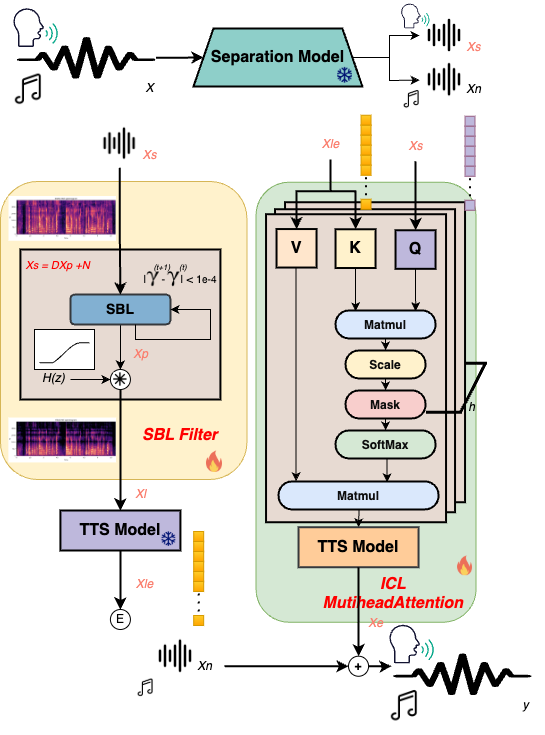
Figure 1. SeamlessEdit separates human voice Xs and suppresses residual noise to derive an edited speech Xle. In-context refinement enhances the editing of Xs using Xle for indistinguishable noisy editing results. The SBL filter is adopted to improve robustness to noise.
Speech Separation
StoRM, a diffusion-based stochastic regeneration model, separates the input into voice Xs and background noise Xn in a few diffusion steps.
Frequency-Band Aware Suppression
Sparse Bayesian Learning (SBL) estimates the sparse voice frequency bands; a Butterworth SBL filter suppresses uniformly distributed residual noise to yield Xl.
Neural Codec Editing
A VoiceCraft-based editing model performs insertion, deletion, and substitution over the masked target region, producing Xle.
In-Context Refinement
A multi-head attention module uses low-frequency embedding Xle (K, V) to enhance Xs (Q); the separated noise Xn is added back to form output Y.
Results
Insertion and replacement on the EARS-WHAM dataset under noisy conditions.
| Model | Insertion | Short Replacement | Long Replacement | |||||||||
|---|---|---|---|---|---|---|---|---|---|---|---|---|
| WER↓ | PES↓ | NMOS↑ | SMOS↑ | WER↓ | PES↓ | NMOS↑ | SMOS↑ | WER↓ | PES↓ | NMOS↑ | SMOS↑ | |
| Ground Truth | – | – | – | – | 0.12 | 0.51 | 3.97 | 3.82 | 0.12 | 0.51 | 3.97 | 3.82 |
| VoiceCraft* | 0.18 | 0.56 | 4.23 | 4.11 | 0.10 | 0.52 | 4.25 | 4.19 | 0.10 | 0.54 | 4.32 | 4.23 |
| FluentSpeech | – | – | – | – | 0.23 | 1.82 | 1.67 | 1.66 | 0.22 | 1.84 | 1.50 | 1.49 |
| VoiceCraft | 0.33 | 1.28 | 2.93 | 2.76 | 0.24 | 1.23 | 2.90 | 2.99 | 0.23 | 1.16 | 2.93 | 2.60 |
| SeamlessEdit w/o ICL | 0.28 | 0.89 | 3.75 | 3.48 | 0.23 | 0.80 | 3.38 | 3.12 | 0.24 | 0.86 | 3.42 | 3.13 |
| SeamlessEdit (ours) | 0.28 | 0.77 | 3.78 | 3.43 | 0.22 | 0.72 | 3.56 | 3.13 | 0.22 | 0.75 | 3.65 | 3.11 |
Table I. Lower WER/PES and higher NMOS/SMOS are better. “*” denotes the clean condition (upper bound). SeamlessEdit achieves the best noisy-condition NMOS and lowest PES, with a +29.01% NMOS and +24.28% SMOS gain over state-of-the-art systems.
Audio Demos
Listen to insertion and replacement results under noisy conditions. In each transcript, green marks inserted words and red marks replaced words.
Citation
If you find this work useful, please cite:
@inproceedings{chen2026seamlessedit,
  title     = {SeamlessEdit: Background Noise Aware Zero-Shot Speech Editing with in-Context Enhancement},
  author    = {Chen, Kuan-Yu and Li, Jeng-Lin and Lu, De-Yan and Ding, Jian-Jiun},
  booktitle = {European Signal Processing Conference (EUSIPCO)},
  year      = {2026},
  note      = {arXiv:2505.14066}
}